Efficient Content Storage & Indexing (ECSI) is an advanced data storage system for Contextual Related Posts Pro and Better Search Pro, significantly improving the quality of related posts and search results with enhanced performance. The post content is stored in custom database tables optimized for search and retrieval. This feature was first introduced in Contextual...
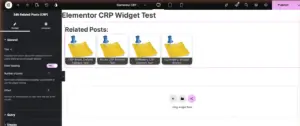
Contextual Related Posts Pro v4.4.0 adds native “Related Posts (CRP)” elements for three popular page builders: WPBakery Page Builder, Elementor, and Bricks Builder. Each integration is experimental — the underlying rendering is stable (it reuses the shortcode), but the builder-side controls are new and feedback is welcome while they settle in. WPBakery Page Builder If...
Lazy loading, introduced in Contextual Related Posts Pro v4.3.0, defers rendering the related posts until the visitor is about to scroll them into view. The page is served without running the related posts query, and the list is fetched in the background via the REST API. Why lazy load? The trade-off: the related posts links...
Contextual Related Posts includes a Related Posts block that can replace the widget or shortcode. You can use it in posts, pages, custom post types, and block theme templates. Contextual Related Posts Pro adds two more choices: a Contextual Related Posts variation of the core Query Loop and a standalone Related Posts Advanced block. Both...
Since v3.1.0, Contextual Related Posts has included support for viewing the related posts via the WordPress REST API. The plugin registers the contextual-related-posts/v1 namespace to retrieve related posts for a particular post ID. Pro features also register specialized endpoints in this namespace for rendered HTML and block-editor previews. Since v4.5.0, the plugin also registers abilities through...
Contextual Related Posts has several customization options available via the Settings page in WordPress Admin. You can access this via Settings » Related Posts. A typical HTML output for the plugin is below. The plugin also provides you with a set of CSS classes that allow you to style your posts. The main CSS classes...
Contextual Related Posts v3.0.0 introduced CRP_Query, which works as a wrapper for WP_Query. This brings all the power and flexibility of WP_Query to Contextual Related Posts. If you’re not familiar with WP_Query, I recommend reading docs. Standard Loop get_crp_posts() get_crp_posts() is a wrapper for CRP_Query and can be used to retrieve an array of related...
Contextual Related Posts CLI (CRP-CLI) offers an efficient way to manage Contextual Related Posts via the command line. This tool is part of Contextual Related Posts Pro starting from version 4.2.0. About WP-CLI WP-CLI is a set of command-line tools for managing WordPress installations. You can update plugins, configure multisite installations, and much more, all...
Contextual Related Posts 4.5.0 registers abilities with the WordPress Abilities API. The shared ability retrieves related posts; Contextual Related Posts Pro adds abilities to clear the cache and change a post’s exclusion status. Requirements The WordPress Abilities API toggle on the Features settings tab controls whether CRP registers its abilities. It is enabled by default....
Contextual Related Posts caches its related posts so that repeat visitors do not re-run the query. Since 4.5.0 the cache is kept fresh automatically when you save a post, and this page documents the filters that control that behavior. What happens when you save a post Saving a post does two things: Both parts skip...
Contextual Related Posts works with WPML, Polylang, and TranslatePress, and no configuration is needed for any of them. On a multilingual site, related posts are matched to the language being viewed, and cached output is stored per language so visitors never see another language’s titles or links. Supported plugins Plugin How related posts are handled...
Contextual Related Posts (CRP) boosts user engagement by displaying relevant posts at the end of each article. Its algorithm taps into MySQL’s full-text search to deliver smart, context-aware suggestions. Core Functionality At its heart, CRP uses MySQL FULLTEXT indexes to analyze post content. CRP examines the posts’ fields, including the post title and content. This...