

Top 10 offers various tracking methods to efficiently record post views. Each tracker type has unique benefits and considerations. The sections below explain the different types of trackers available in the Top 10 WordPress plugin to help you select the best option for your site.
The plugin interface uses Custom period for what was historically called Daily. When the range is set to 1 day, labels read Daily; for longer ranges they read Custom (N days). Internally, the database table, tracker settings, and many API parameters still use the word daily for backward compatibility.
Data source and tracking
The Data source setting controls whether Top 10 records new views. Top 10 and Hybrid keep tracking enabled. Koko Analytics only stops Top 10 tracking, including feed pixels and Pro Fast and High-traffic trackers, while Koko Analytics powers popular posts lists.
If Koko Analytics is unavailable, Top 10 falls back to its own data and tracking. Clear your page cache after changing modes so pages use the current tracker setup.
Selecting the Tracker
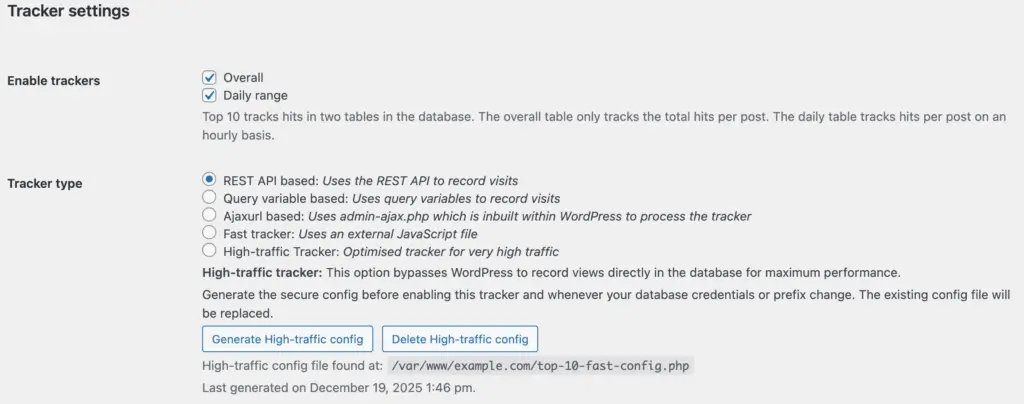
The tracker can be set in the Top 10 > Settings > Counter/Tracker. Scroll down to tracker settings and select the Tracker type.
Tracker Types
- REST API-Based Tracker: Utilizes the WordPress REST API to record visits using a custom endpoint
top-10/v1/tracker. Offers flexibility and can be used directly in your web app. This will not work if REST API requests are blocked on your website. - Query Variable-Based Tracker: Records visits using query variables appended to URLs. Simple and straightforward implementation, and should work with most sites.
- Ajaxurl-Based Tracker: Leverages the built-in
admin-ajax.phpfile to process tracking requests. A good alternative to the Query Variable-based tracker. - Fast Tracker (Pro only): A lightweight standalone PHP endpoint (
fast-tracker-js.php) that handles tracking requests with a minimal WordPress bootstrap — no themes, widgets, or most plugins are loaded. This significantly reduces server overhead per tracked visit. If your hosting or a security plugin blocks access to the file, whitelist/wp-content/plugins/top-10-pro/includes/pro/fast-tracker-js.php. - High-traffic Tracker (Pro only): Bypasses WordPress entirely. Tracking requests are handled by
high-traffic-tracker-js.php, which reads a pre-generated config file (top-10-fast-config.php) placed in the WordPress root containing hardcoded database credentials. You must generate this config file from Top 10 > Settings before the tracker will work, and regenerate it whenever your database credentials or table prefix changes.
How Tracking Works
Understanding the full tracking flow helps you diagnose issues and explains why counts may appear with a short delay. This section describes Funnel tracking, the default Tracking method. See Legacy tracking for how views are recorded when Legacy is selected.
Step 1 — A visit is recorded
When a visitor loads a post, the tracker JavaScript fires a request to the configured tracker endpoint. With Funnel tracking, whichever tracker type you choose, each visit inserts one row into the visits funnel table (wp_top_ten_visits_funnel). Each row stores the post ID, blog ID, timestamp, traffic source (web or RSS feed), and which counters to update (overall, daily, or both).
top-10.js (top-10.min.js) instead of top-10-tracker.js — the old filename tripped ad-blocker rules that match “tracker”. If you or a security plugin had whitelisted the old filename, update that rule to the new name.Writing a single row to the funnel is fast and lightweight — it does not touch the main count tables during the page request.
Step 2 — The funnel is aggregated (every 2 minutes by default)
A WordPress cron job (tptn_aggregation_cron_hookOpens in a new window) runs every two minutes by default and processes the funnel. In a single database transaction it:
- Copies funnel rows to the visits log table (
wp_top_ten_visits_log) — a raw audit trail of every visit. - Aggregates funnel rows into the daily count table (
wp_top_ten_daily) — one row per post per hour, incremented by the number of funnel rows in that hour. - Aggregates funnel rows into the overall count table (
wp_top_ten) — one row per post, running total. - Deletes the processed funnel rows.
All four steps run inside one transaction. If anything fails the transaction rolls back cleanly and the next cron run retries the same rows — there is no risk of double-counting.
Feed views are included in regular counts. From 4.6.0, once feed view counts are enabled, their share is also stored separately for the Pro Feed vs web report. This does not double-count views.
Step 3 — Old data is pruned
A separate maintenance cron (tptn_cron_hookOpens in a new window) runs on the schedule you configure and removes old entries from both tables — but with different retention periods:
wp_top_ten_daily— retains data for 180 days by default (controlled byTOP_TEN_STORE_DATA/tptn_maintenance_daysOpens in a new window filter).wp_top_ten_visits_log— retains data for 30 days by default (controlled byTOP_TEN_LOG_STORE_DATA/tptn_log_retention_daysOpens in a new window filter).
The log uses a shorter window because it stores one raw row per visit and grows proportionally to traffic. Once aggregation has run, those rows are already reflected in the count tables and serve only as an audit trail. See Maintenance options for how to adjust either retention period.
Legacy tracking
Set Tracking method to Legacy in Top 10 > Settings > Counter/Tracker and each visit is written straight to wp_top_ten and wp_top_ten_daily during the tracker request. The funnel and the aggregation cron are skipped, so counts update immediately, and the visits log table is not populated.
Use Legacy if counts are not updating, for example when WP-Cron is disabled or unreliable. The Fast and High-traffic trackers follow this setting too. Regenerate the High-traffic config file after changing it.
Changing the aggregation interval
The default two-minute interval can be changed using the tptn_aggregation_cron_intervalOpens in a new window filter. The value must be a registered WP-Cron schedule name. Top 10 registers the following schedules out of the box:
| Schedule name | Interval |
|---|---|
one_minute | Every 1 minute |
two_minutes | Every 2 minutes (default) |
three_minutes | Every 3 minutes |
five_minutes | Every 5 minutes |
Example — run aggregation every 3 minutes:
If you supply a schedule name that is not registered, WordPress will fall back to the nearest available interval. The change takes effect automatically on the next admin page load — no need to deactivate and reactivate the plugin.
Syncing the funnel manually
If you need counts to update immediately — for example after importing data or testing — you can drain the funnel without waiting for the next cron run. Go to Top 10 > Tools and click Sync Funnel Now. This runs the same aggregation the cron would run, instantly moving all buffered visits into the count tables.
The four database tables at a glance
| Table | Purpose |
|---|---|
wp_top_ten | Running total of all-time views per post |
wp_top_ten_daily | Hourly view counts per post (powers the dashboard chart and custom-period popular posts lists) |
wp_top_ten_visits_funnel | Hot buffer — raw incoming visits waiting to be aggregated (normally empty between cron runs) |
wp_top_ten_visits_log | Cold archive — every individual visit, retained for the configured number of days |
Choosing the Right Tracking Method
The optimal tracking method depends on your website’s specific requirements. Consider the following factors:
- Website size and traffic: The High-traffic or Fast Trackers are best suited for large/high-traffic websites due to their performance advantages. On most sites the REST API or Query Variable tracker works perfectly well.
- Plugin compatibility: Ensure the chosen tracking method is compatible with other plugins you’re using. If any plugin or your hosting blocks access to the Fast Tracker file, whitelist
/wp-content/plugins/top-10-pro/includes/pro/fast-tracker-js.php. - Caching: Page caching does not interfere with tracking. Each visit still fires the tracker JS regardless of whether the HTML page itself was served from cache.
Using Koko Analytics instead
If you run Koko Analytics, the Koko Analytics only data source switches off every Top 10 tracker and builds popular posts lists from Koko Analytics page views. See Use Koko Analytics as the data source for Top 10.
Additional Tips
- Test and monitor: Experiment with different tracking methods to determine the best performance for your website.
- Regularly review and update: Stay up to date with the latest Top 10 version and best practices.
- Debug mode: Enable Debug mode in Counter/Tracker settings to have the tracker output a response in the browser console, which is helpful when troubleshooting why counts are not updating.
By understanding the different tracking methods available in Top 10, you can make an informed decision and ensure accurate and efficient post view tracking on your WordPress website.
 Use Koko Analytics as the data source for Top 10
 Blocks in Top 10